Where the name comes from
CFL stands for compact fluorescent lamp. Glass Alchemy, a company that makes colored glass rod for glassblowers, says its color Serum was "the original CFL-reactive color": champagne yellow in natural light, soft pink under a CFL. Glass Alchemy's Thomas Grimmett wrote in 2017 that when the color came out, "the term 'CFL' was not used by anyone in our industry to describe a color or its characteristics."
Other color makers have their own versions. Northstar's Gemini, made with Gaffer Glass, is described as purple in natural light and light cobalt blue under a 2700K CFL. Trautman Art Glass describes its Phaze as bright magenta under fluorescent light and close to clear champagne otherwise, and Elev8 Glass Gallery calls colors like these "shifty."
Warm lightAmber gold
Fluorescent lightViolet-blue
Why the color moves
The color makers don't say what's in their CFL colors, but general glass science explains the effect.
Fluorescent bulbs give off light in a few narrow bands of color instead of a smooth spread (a Corning patent puts the sharpest at about 545 and 620 nanometers), and some glass soaks up light in narrow bands too. Change the light and the bands line up differently, so the same glass looks like a different color. Corning's patent describes a glass made with rare earths that looks pink under incandescent light and green under fluorescent light.
What changes it
- The bulb. Elev8 Glass Gallery says the glass reacts to any fluorescent light, not just the compact bulbs, and that how warm or cool the bulb is changes how far the color moves (Northstar's description of Gemini names a 2700K CFL).
- Thickness. Bullseye, which makes glass for fusing rather than for pipes, notes that its shift colors change with thickness as well as with the light.
- Blacklight is a different thing. UV-reactive glass glows under a blacklight, and nothing we found says CFL colors glow.
For LED bulbs, the only note we have is for Northern Waters' rig: LED bulbs vary in how far they push it toward violet, fluorescent tubes show the shift most, and sunlight keeps it golden.
Seeing it in the photos
A product photo is taken under one light, so it can't show the shift. When we know both colors, the piece's page says what they are, like on Northern Waters' rig. If you want to know how a piece looks under a certain light before you buy, ask us.
Where to see it
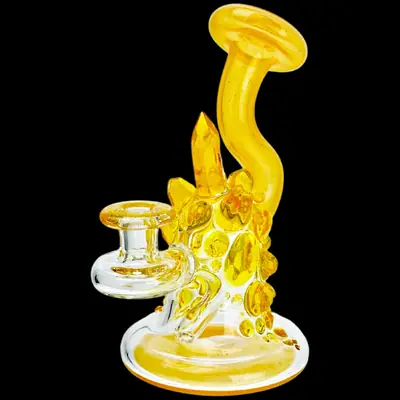
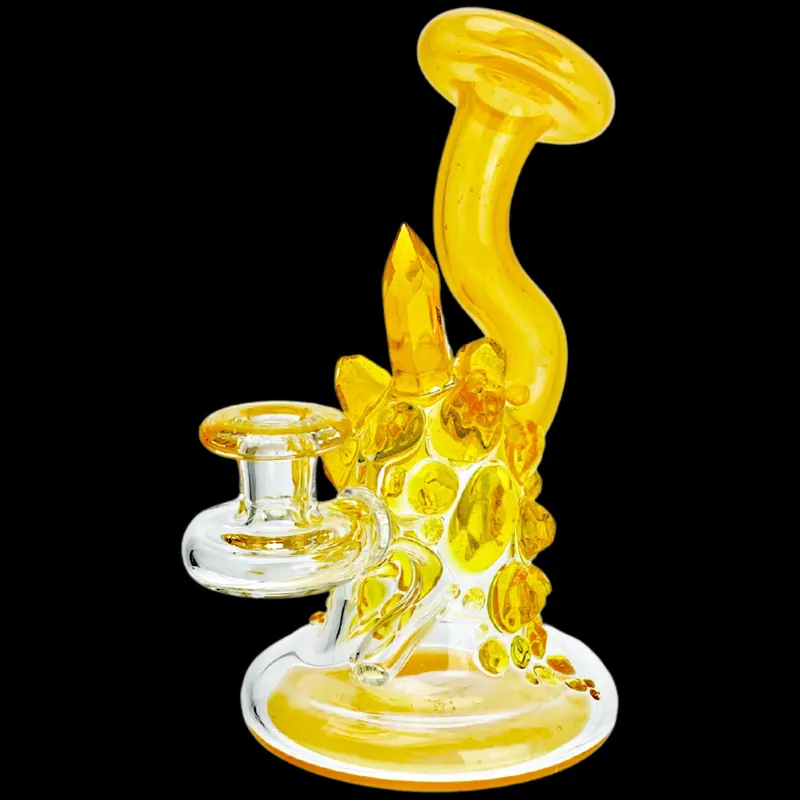
- Northern Waters' sculpted rig ($949.95): the whole body and its faceted crystal clusters are CFL glass, amber in warm light and violet-blue under fluorescent light.
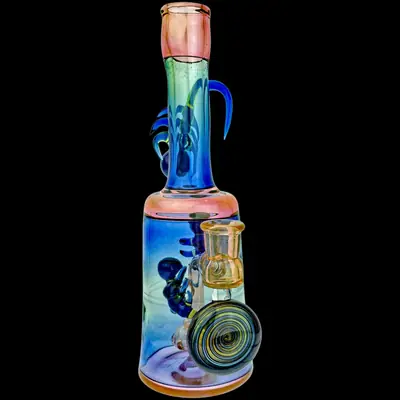
- PHD Glass's faceted bottle ($949.95): CFL color throughout, yellow in the photos.
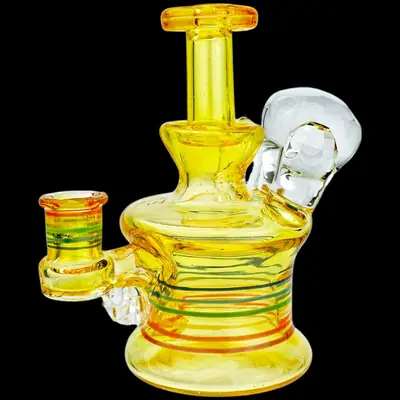
- Whitney Harmon and Skar's collab ($1,610.00): its two-tone color includes CFL reactive glass.
Sources
- Glass Alchemy, Serum, champagne yellow in natural light, soft pink under CFL; Glass Alchemy's claim that Serum is 'the original CFL-reactive color'
- Thomas Grimmett, CFL Potion, Glass Alchemy (2017), that 'CFL' wasn't used in the industry to describe a color at the time
- Elev8 Glass Gallery, What does CFL and Shifty mean? (2018), the glass reacts to fluorescent light generally; the shift depends on the bulb's color temperature
- ABR Imagery, Northstar Gemini rod, purple in natural light, light cobalt blue under a 2700K CFL
- ABR Imagery, Trautman Art Glass Phaze rod, bright magenta under fluorescent light, close to clear champagne otherwise
- Corning Inc., US patent 11,535,549 B2, Multichroic glasses with praseodymium and neodymium, fluorescent light's sharp emission bands, and glass that looks pink under incandescent and green under fluorescent
- Bullseye Glass, Light Neo Lavender Shift Tint, shift hues change with the light source and with thickness