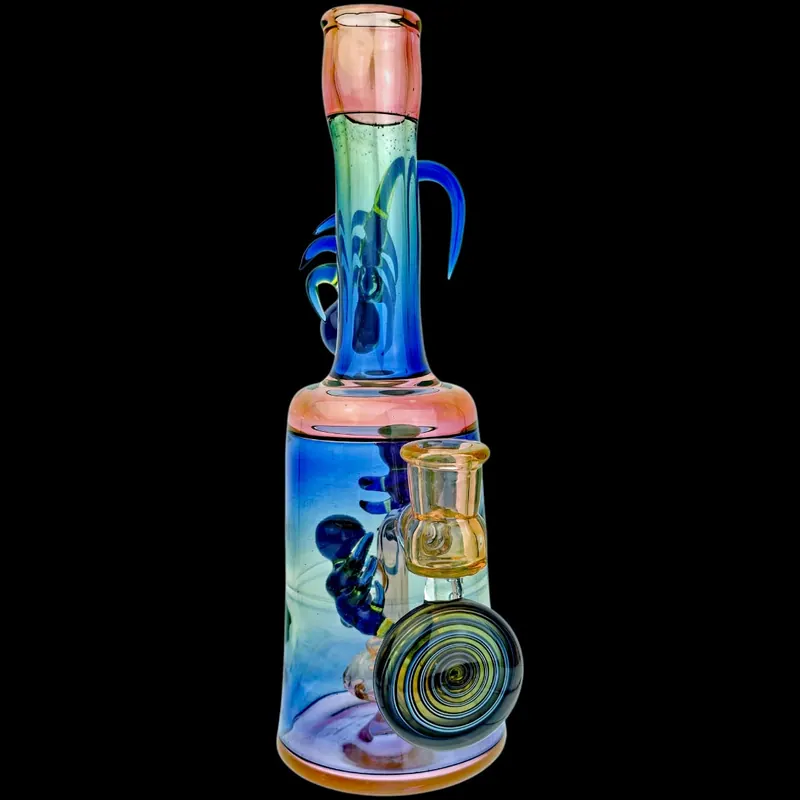
Where heady glass started
Tacoma's Museum of Glass and the Flint Institute of Arts both trace it to the 1980s, when the glassblower Bob Snodgrass started making small color-changing pipes and selling them at Grateful Dead shows. By the late 1980s, the Corning Museum of Glass says, he was teaching students in and around Eugene, Oregon.
The color change came from fuming, which he's widely credited with developing. Silver or gold burned off in the flame leaves a very thin layer on the glass. The color it shows depends on what's behind it, so silver that looks faintly yellow on clear glass turns blue or green against something dark.
For years a lot of this work stayed out of sight, and Corning notes that many makers worked under made-up names. Several of the makers here go by one name or a studio name.
When museums started collecting it
In 2019 the Corning Museum of Glass took in a pipe by David Colton and called it the first piece of functional glass (the field's own name for pipes) to enter an art museum's collection. Its curator, Susie J. Silbert, said at the time: "Pipes are one of the most important areas of glass production in the 21st century." In spring 2025, Tacoma's Museum of Glass put on Joint Venture, a show with Joe Tsoulfas of Bigspin Glass as its curator and work by Banjo, Hugh Glass and others.
Where the word "heady" comes from
There's no settled answer. Shops tell several stories, from showpieces called headpieces to the old head shops, and no dictionary or museum backs any of them.
What makes one piece heady and another not
Leafly describes heady pieces as prized for their artistry and the skill it took to make them, as opposed to "the mass-produced pipes lining the shelves of smoke shops." Beyond that, people argue about where the line is. Dab Nation weighed the arguments in 2021 and decided it's up to the person looking.
For us, a heady piece is one where you're paying for the maker's handwork: worked color like wig wag, fillacello and CFL, sculpted figures, one-off builds. Most of our pieces come with the maker's name. A few don't. Those come in several of the same design, like the printed and decal beakers, and their pages say so.
What to look for in a piece's photos
- Who made it. Start with the maker's name. Our maker pages only say what we know from their pieces and from the maker's own pages, with links.
- Whether the color is in the glass or on it. Worked color follows the curve of the glass and changes a little from one band to the next. A decal repeats exactly and sits flat on the surface. The wig wag page shows the difference on two pieces here.
- Every angle. Handmade pieces vary, so photos of the piece itself tell you more than any description. All our photos are real, and when one shows more than one piece, the caption says so.
- A signature. CU Independent points out that a secondhand piece with no signature or record of sale is hard to verify, and Leafly's advice is to ask for proof of who made a piece if you're not sure. One shop's guide to spotting real Mothership glass suggests a certificate of authenticity or photos from the piece's original release. We only call a piece signed when we know the signature is there, like on the Whitney Harmon and Skar collab, which has a Whitney Harmon millie set into the base.
- A record of the sale. One-of-a-kind pieces that sell here stay on the site, marked sold, with their photos and the maker's name. The sold page lists them.
Functional and non-functional glass
Museums use "functional glass" for pipes; Tacoma's Museum of Glass says pipes are what it's more commonly called. Non-functional glass is made to look at or wear, and Leafly calls it "purely aesthetic," using pendants as the example. The line isn't sharp, though. GlassPass, a heady marketplace, files pendants under non-functional but describes some as display-only and others as working pieces. Our turtle and spiral pendants are sold for wearing or display.
Sources
- Museum of Glass (Tacoma), Joint Venture (2025), pipe making from scientific glass techniques began in the 1980s with Bob Snodgrass, selling at Grateful Dead concerts; functional glass is more commonly known as pipes
- Flint Institute of Arts, Torched: Glass Pipes (2023), Snodgrass's small color-changing pipes in the early 1980s; artists who had to protect their identities
- Eric Goldschmidt, The Pipemakers' Day Has Finally Come, Corning Museum of Glass blog (2019), teaching in and around Eugene, Oregon, from the late 1980s; makers working under pseudonyms
- Corning Museum of Glass, press release on the 2019 Rakow Commission, David Colton's pipe as the first piece of functional glass in an art museum's collection; Susie J. Silbert's quote
- Chameleon Glass, Color Change, fuming leaves a very thin layer of precious metal; silver leaves a slightly yellow hue and changes to blues and greens
- Leafly, Heady glass (glossary), glass prized for its artistry and the skill used to make it, without giving up function
- Patrick Bennett, How to Choose Your First Heady Glass Pipe, Leafly (2018), heady set against mass-produced pipes; non-functional glass as purely aesthetic, with pendants as the example
- Seth Styles, The Struggle to Determine What Truly Constitutes Heady Glass, Dab Nation (2021), competing stories for the word, and the view that where the line falls is up to the person looking
- Inside the world of heady glass, CU Independent (2026), a secondhand piece without a signature or a sale record is hard to verify
- Angie's Boutique, How to authenticate Mothership glass, a certificate of authenticity or a photo history from the original drop
- GlassPass, pendants, pendants filed as non-functional, some display-only and some working