What reticello is
Reticello comes from Murano, the Venetian glassmaking island, where glassmakers worked it out in the 1500s. It's one of the filigrana techniques, which use canes of clear glass with white or colored threads inside. The Corning Museum of Glass describes reticello as canes "organized in a crisscross pattern to form a fine net," sometimes with tiny air bubbles trapped in it.
At the furnace, the net is made in two layers. One bubble is blown with its threads spiraling one way, a second with them spiraling the other way, and one is fused inside the other. Where the lines cross, the layers touch, and small pockets of air stay trapped in the diamonds between them.
How fillacello fills the net
At the torch, the glass historian Paul Engle writes, the lines are laid onto tubing with stringer, thin rods of glass, then twisted and filled in with color, a version that was "playfully dubbed 'fillacello.'" High Times described it the same way in 2017: fillacello "comes from the reticello technique" and fills in the spaces with color.
1. Lines twisted one wayLines of color spiral around the glass.
2. A second layer the other wayThe net of crossed lines is reticello.
3. Fill the diamondsThat's fillacello.
Who started it
Engle found the first torch-made examples on the West Coast around 2005 to 2007, and he writes that nobody knows for sure where it started. The Dab Lab credits Eusheen and Adam Reetz with developing it, and High Times calls it Kevin Murray's specialty.
Fillacello, reticello and wig wag side by side
| Pattern | What you see | Where to see it |
|---|---|---|
| Reticello | A net of crossed lines, the diamonds left clear | nothing in stock |
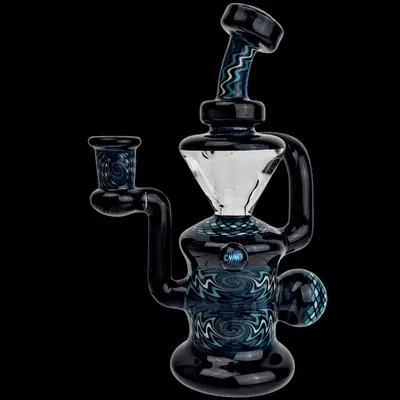
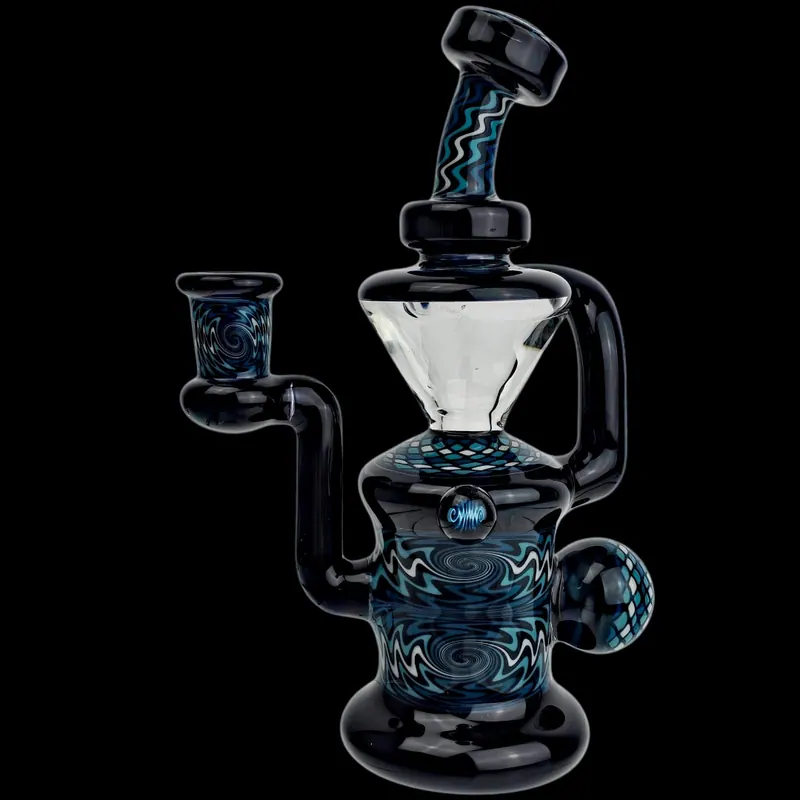
| Fillacello | The same net, each diamond filled with color | McDoogle Glass's recycler, $964.95 |
| Wig wag | Lines folded back and forth into zigzags, no crossing net | wig wag pieces |
Where to look on the McDoogle recycler
The pattern is on the lower can and the round marble at its side, in dark blue and white against black glass, with the recycler's clear funnel above it. Its page has five photos from different sides; it's 8 inches tall ($964.95).
Sources
- Paul Engle, Reticello Glass, Conciatore (2019), how reticello is made; the flamework variant 'playfully dubbed fillacello'; first examples on the West Coast around 2005 to 2007; origin unclear
- Corning Museum of Glass, Glass Dictionary: vetro a reticello, a fine net of crisscrossed canes, which may hold tiny air traps
- Corning Museum of Glass, Glass Dictionary: filigrana, the cane family reticello belongs to, from 16th-century Murano
- The Dab Lab, Exploring Borosilicate Glassblowing Art Techniques (2019), credits fillacello to Eusheen and Adam Reetz
- Ab Hanna, High Times (2017), fillacello comes from reticello and fills the spaces with color