What you're looking at
Wig wag shows up as bands of stripes that change direction again and again, so the lines meet in points instead of running straight or spiraling one way. It's usually worked in sections: a band around a can, a stretch of neck, a ring at the base.
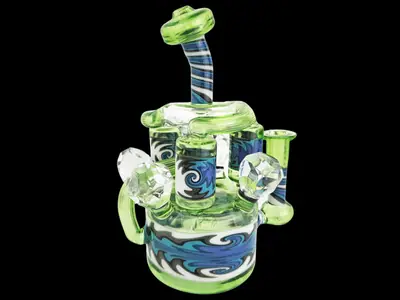
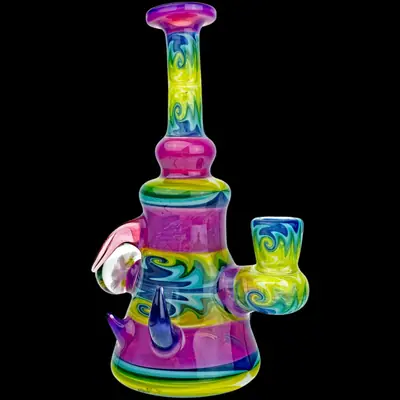
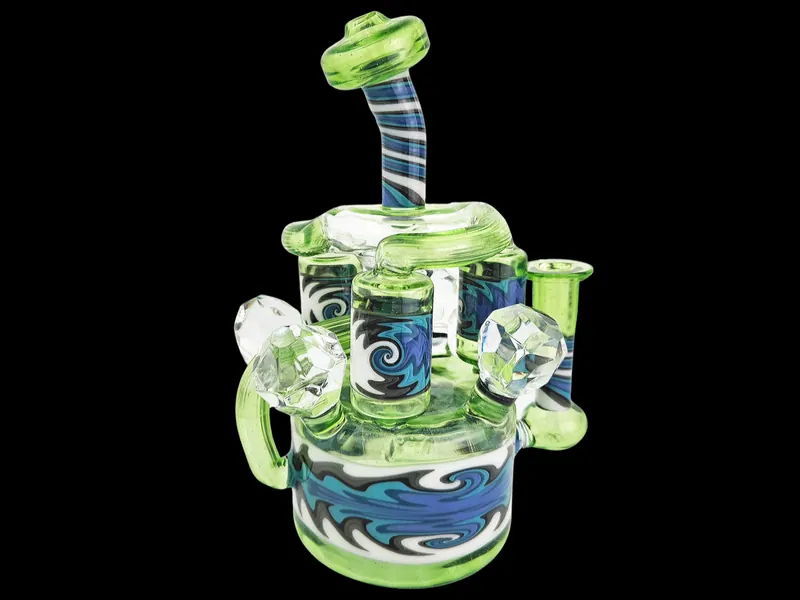
On the 710 Sci Glass recycler the pattern wraps the three cans and the base in blue, white and black, set in light green glass. Lyle's rig is built in wig wag sections: separate bands of the pattern stacked up the body and neck.
1. Lines of color on the tubeRods of color made into tubing, or stripes laid on a gather.
2. Heat it and twist one wayThe stripes lean into a spiral.
3. Twist back, and againEach change of direction folds the lines into a point.
How a wig wag gets made
- Put the color in. Legacy Glassworks describes wig wag as starting from rods of color hand-made into solid color tubing. The Bay Area Glass Institute teaches it as part of lineworking, with lined borosilicate tubing. At small scale, bead makers lay stripes of thin colored glass (stringer) on a gather.
- Heat a section and twist. With the glass soft, the section is turned one way so the lines lean into a spiral. One tutorial describes pulling about an inch of the gather out "as if you were pulling a twistie, but then stop," and twisting two or three times.
- Reverse it. The section is twisted back the other way, then back again. Each reversal folds the lines into the zigzag that gives the pattern its look.
- Build the piece from it. The worked tubing or cane becomes part of the piece: a can, a neck, a band. That's why wig wag usually appears in sections, like the cans on the 710 Sci Glass recycler.
Wig wag, reversals and linework
The words overlap, and shops don't all use them the same way:
| Word | How the sources use it |
|---|---|
| Linework | Lines of color worked through the glass; wig wag is one kind |
| Wig wag | Lines twisted back and forth until they zigzag |
| Reversal | A wig wag where the axis is switched while the piece is being blown (Legacy Glassworks); some shops treat it as another word for wig wag |
Worked into the glass, or printed on
Every source we found describes wig wag as color worked into the glass at the torch. Our 16 inch beaker ($74.99) has the same zigzag look, but as a decal, a pattern printed on the surface, and its name says so. In the photos, the decal repeats exactly and sits flat on the outside of the tube. The worked bands on the 710 Sci Glass recycler ($1,149.95) follow the curve of each can and change a little from band to band.
If a piece's page doesn't make clear which kind it has, ask about it before you buy.
Sources
- Legacy Glassworks, Glassblowing Info, wig wag as hand-made color tubing twisted back and forth; a reversal as a wig wag with the axis switched
- Bay Area Glass Institute, Lineworking with Borosilicate Tubing (class), wig wag taught as part of lineworking, with lined borosilicate tubing
- The Blue Between, How to make wig wags (2011), the pull, twist and reverse at small scale
- Glass Line magazine, Volume 26 index, the 2012 tutorials 'A Wigwag Cane' and 'Encalmo Reversal Ashtray'
- Corning Museum of Glass, Rakow Library pipe making guide: techniques, wig wag among the decorative techniques covered by Glass Line tutorials
- The Dab Lab, Head Shop Dictionary (2015), how shops use wig wag and reversal, sometimes for the same thing